

How Much Revenue Does Your Business Need to Give You Financial Freedom?
humana Network
Editorial
TL;DR
Separate your personal cost of living, business revenue target, and invested wealth. Calculate how much you need to sell based on your contribution margin, and explore financial independence scenarios without confusing revenue with cash flow.
Your business needs to generate enough revenue to cover its costs, pay you a sustainable income, set aside money for taxes and unexpected expenses, and fund your goals. That amount is different from your sales revenue and from the invested wealth you need for financial independence. Calculating these three numbers separately helps you design a business that supports the life you want.
Three financial numbers you need to distinguish

A business can generate substantial revenue and leave you with very little money. It can also be profitable and still experience cash flow problems because clients pay late. A high income that depends entirely on your working hours is not the same as financial independence.
1. Calculate your actual cost of living
Review your expenses over the past three to six months and annualize irregular payments. Include housing, food, healthcare, transportation, insurance, dependents, rest, and professional development. Create three scenarios: essential, desired, and expansive. Don't eliminate important needs simply to make your target look achievable.
Hypothetical example in USD: $1,200 in essential expenses, $400 in additional lifestyle expenses, and $400 in savings and investments. Your personal after-tax income target would be $2,000 per month. Adjust the currency, inflation, and circumstances to your own situation.
2. Separate your personal and business finances
Create an operating budget separate from your personal budget. Track fixed costs (software, rent, permanent team members), variable costs (commissions, supplies, project-based contractors), and tax obligations. Determine how to pay yourself based on your business structure and applicable regulations.
Money available in your business bank account is not necessarily money you can withdraw. Some of it may be earmarked for taxes, outstanding payments, or client advances.
3. Calculate your business revenue target
The Small Business Administration uses the contribution margin to calculate how many units a business needs to sell to cover its costs. We can adapt that logic to a personal income goal.
Contribution margin = (sales excluding indirect taxes − variable costs) / sales excluding indirect taxes.
Target revenue = (fixed costs + target owner compensation before personal taxes + additional reserves/reinvestment) / contribution margin.
This is a simplified model. Account for business taxes according to your business structure and avoid double-counting expenses already included in your costs. If your contribution margin is zero or negative, increasing sales won't solve the problem.
Example: an independent consultant
An independent consultant wants to take home $2,000 per month. For illustration, she assumes an effective personal tax rate of 20%, which means she needs gross compensation of $2,500. This is not a recommended tax rate, nor does it apply to every country.
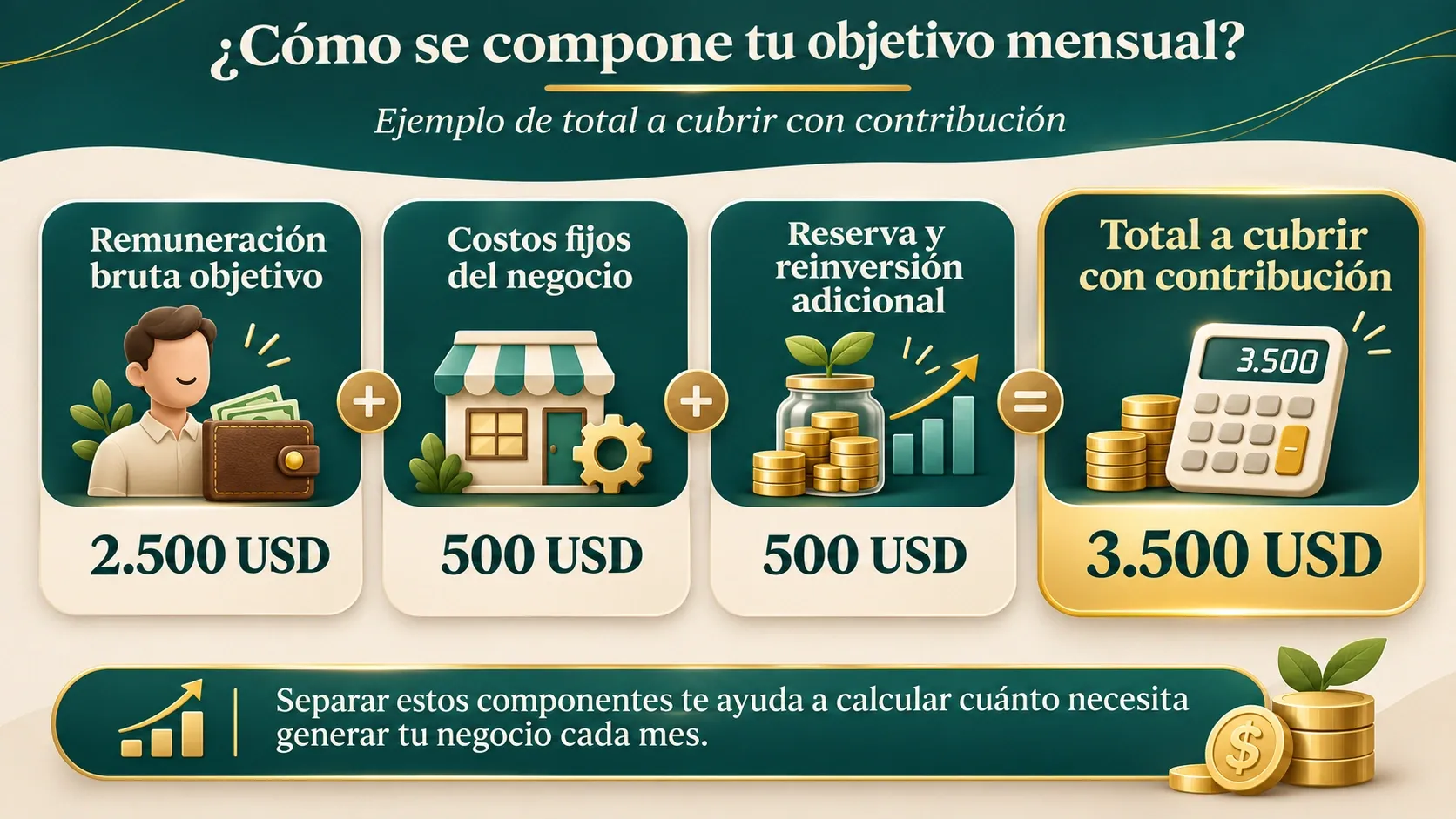
With variable costs of 30% of sales, her contribution margin is 70%. She needs $5,000 in monthly revenue, excluding indirect taxes collected on behalf of the government. Of that $5,000, $1,500 covers variable costs and $3,500 funds the items shown in the illustration. In a real business, she would need to account for any additional business taxes not included in this example.

Financial freedom isn't just about selling more. Improving your margin, simplifying deliverables, or adjusting your prices can reduce the revenue you need. But cutting costs at the expense of quality, health, or stability isn't a good solution either.
4. Translate your revenue goal into sales and working hours
If each project generates $1,000 in revenue at the assumed margin, you need five projects per month. If each project requires 20 hours of delivery time, that's 100 hours before accounting for sales, administration, and professional development.
Does that workload fit your ideal week? If not, review your pricing and project scope, consider a recurring offer, delegate tasks when your margin allows it, or develop assets you can sell without repeating all the work. Every option has costs and risks; a digital product doesn't automatically generate income.
5. Build a cash reserve
The Consumer Financial Protection Bureau's guide to emergency funds recommends building a reserve that reflects your personal circumstances. Distinguish your personal emergency fund from your business operating cash reserve.
Simulate a month in which sales fall 30% below your target. In the example, your revenue would be $3,500. At a 70% contribution margin, you would have $2,450 left to cover fixed costs and planned allocations—a $1,050 shortfall compared with your plan. Which expenses could you postpone, and which cannot wait?
Track when payments are due and when you expect to receive them. A signed sale won't pay a bill until the money comes in.
6. Calculate the invested wealth that could support your life
If you wanted to cover $2,000 in monthly expenses through withdrawals from investable assets, you would need $24,000 per year before tax adjustments.
Estimated capital = annual expenses to be funded / assumed withdrawal rate.

These are mathematical scenarios, not investment recommendations or guaranteed safe withdrawal rates. Inflation, taxes, fees, retirement duration, volatility, and the sequence of investment returns can change the outcome. If some of your expenses are covered by income that doesn't depend on your work, calculate only the remaining gap and consider the risks associated with those income streams.
Don't confuse expected investment returns with a sustainable withdrawal rate. A business that operates without your daily involvement may still require oversight, capital, and risk management.
A 30-day financial freedom action plan
- Week 1: Calculate your actual personal and business expenses, including irregular payments.
- Week 2: Estimate the margin for each service and how much you can pay yourself. Consult an accounting professional about taxes.
- Week 3: Translate your target into prices, clients, and hours. Choose one sales or operational improvement.
- Week 4: Review cash flow, reserves, and contributions toward long-term goals. Make adjustments based on real data, not expectations from an exceptional month.
Frequently asked questions
Do I need a high income to start building financial freedom?
There is no universal income target. Covering your needs, stabilizing cash flow, and creating more room to make your own decisions can be more useful than adopting someone else's financial goal.
Are revenue and profit the same thing?
No. Revenue represents sales, while profit is what remains after the relevant costs and expenses. Cash flow reflects when money enters and leaves your business.
Should I use the 4% rule to calculate my financial independence number?
Not necessarily. It's an assumption for exploring scenarios, not a guarantee. Financial planning requires considering your time horizon, portfolio, risks, taxes, and personal circumstances.
What if my business doesn't generate enough revenue to meet my goal yet?
Identify whether the gap comes from pricing, sales volume, margins, or capacity. Set a realistic intermediate goal and track your progress before taking on new commitments.
Sources and further reading
- SBA: Break-even point calculator.
- CFPB: An essential guide to building an emergency fund.
- humana: How to build a business that depends less on you.
This content is for educational purposes and is not a substitute for personalized financial, tax, or investment advice.
Calculate your financial freedom numbers
Freedom becomes something you can design when you know what you need to fund. With the humana Network Financial Freedom Calculator, you can explore five levels of freedom, estimate the income and capital you need, and turn your goals into concrete scenarios. Sign up for free to access the tool and start with your own numbers.
Get our best stories
A weekly email with curated editorial content for professional women in tech and business.
Related articles
 Negocios y Estrategia
Do More With Less: The 80/20 Rule for Better Results Without Working More
Working all day without making progress? Identify the small share of actions that produces most of your results, then prioritize it to increase sales, productivity, and freedom.
 Finanzas y Dinero
Money Power: Guía para Mujeres hacia la Libertad Financiera y la Riqueza
Descubre cómo tomar el control de tu dinero y construir riqueza con inteligencia.
 Negocios y Estrategia
Empoderamiento Financiero: Cómo Generar Ingresos Pasivos
Descubre cómo generar ingresos pasivos y construir tu independencia financiera con estrategias clave como inversiones, bienes raíces y negocios online. Este artículo te guía paso a paso, desde entender el concepto hasta tomar acción, utilizando herramientas que liberan tiempo, reducen estrés y maximizan tu potencial económico. ¡Comienza hoy a transformar tu relación con el dinero!