
Does Your Personal Brand Attract Clients and Business Opportunities?
humana Network
Editorial
TL;DR
Visibility creates opportunities when connected to positioning, evidence, a clear call to action, and follow-up. Use this LinkedIn profile audit and 30-day plan to turn visibility into meaningful conversations.
Does Your Personal Brand Attract Clients and Business Opportunities?
An effective personal brand isn't measured by followers alone: it should help the right people understand what you solve, trust your expertise, and know how to contact you. If you publish consistently but rarely receive relevant inquiries, you may not need more content. You may need to connect your positioning, offer, and next step.
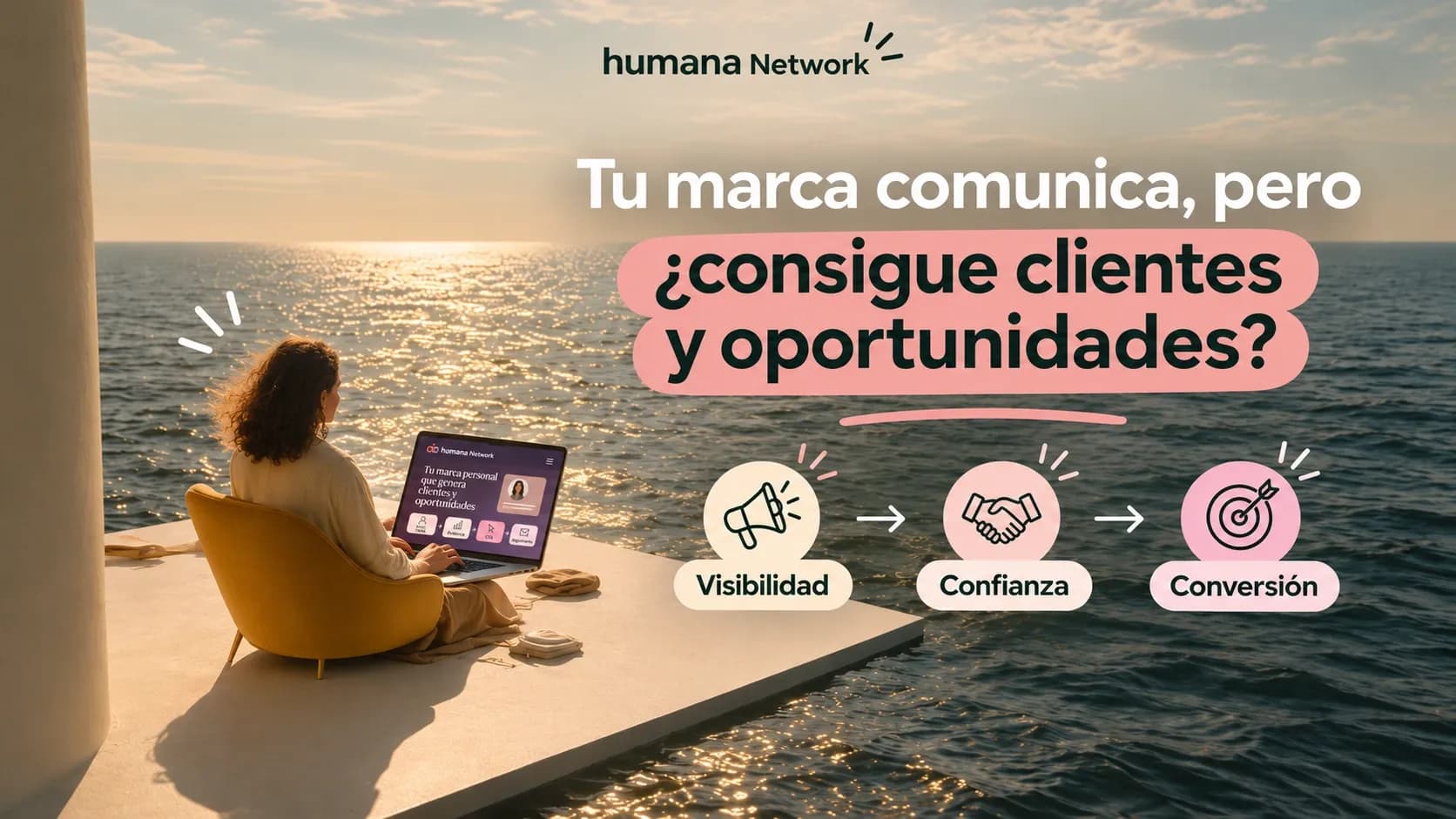
Visibility, trust, and conversion: three different goals
Visibility helps people discover you; trust makes them consider your expertise; conversion happens when someone requests information, signs up, or hires you. A post can receive thousands of views without generating a single inquiry. Another may reach only a few people but spark a valuable conversation.

The personal brand clarity test
Open your profile as if you were a potential client who had never heard of you. Could she tell within ten seconds who you help, what problem you solve, and how to take the next step?
Try a simple statement: "I help [audience] achieve [outcome] through [service or method]." For example, a consultant might say, "I help professional firms organize their inquiries and sales follow-ups so no opportunity depends on someone's memory." She doesn't promise results she can't control; she describes a concrete problem.
You don't need to hide your other interests. But your commercial offer should be easy to understand.
A 15-minute LinkedIn profile audit
1. Headline
Combine your specialty, audience, and benefit. "Process consultant for professional firms" communicates more than a string of buzzwords.
2. About section
Explain what you do, when you can help, how you work, and the next step. Write for a real person, not an algorithm.
3. Evidence
Show a process, a professional decision, or an authorized case study. Avoid invented numbers and testimonials. One well-explained example is often more useful than five adjectives.
4. Featured content
Choose a guide, service page, or example that helps someone make a decision. Don't feature something solely because it received many views.
5. Contact
Check that your link works and people know what to expect when they click. LinkedIn allows professionals to offer services through personal profiles and company pages, with features varying by plan; see the official documentation.
Four types of content that can generate business opportunities
Recognizable problems. Explain a situation your audience experiences and why it happens.
Professional judgment. Show how you choose between two solutions and what trade-offs you consider.
Evidence. Share project lessons or authorized examples, with clear limitations.
Invitation. Introduce a resource, community, or service to people it could genuinely help.
You don't need to publish everything every day. A sustainable combination of two formats may be more useful than a huge content calendar with no clear purpose.
From a post to a conversation: design the entire journey
Imagine posting about a business that depends too heavily on its founder. A reader recognizes the problem and visits your profile. If she finds a clear description, relevant resource, and simple invitation, she can move forward. If your profile talks about everything and the link leads to a confusing page, the conversation ends there.
The minimum journey is: useful content → clear profile → evidence → resource or offer → voluntary contact → relevant follow-up. Don't turn every comment into an automated sales pitch; respect consent and context.
What to measure without obsessing over impressions
Once a month, record relevant conversations initiated, qualified inquiries, meetings, proposals, and hours spent creating content. Ask "How did you discover my work?" rather than attributing everything to the last click. Someone may have seen you on LinkedIn, heard you on a podcast, and finally reached out through a referral.
Small numbers require interpretation: three quality conversations don't establish a definitive trend, but they may reveal which message resonates.
Common personal branding mistakes
Confusing popularity with demand. A viral post may attract people who will never become clients.
Talking only about yourself. Your background matters when it helps explain how you solve a problem.
Hiding your offer. Selling respectfully means explaining how you can help, not pressuring people.
Copying someone else's voice. Consistency is more sustainable than an invented personality.
Promising transformations without evidence. Show your actual capabilities and limitations.
A 30-day personal brand experiment
Week 1: Rewrite your headline, description, and call to action (CTA). Ask two people in your target audience to explain what they think you offer.
Week 2: Publish two pieces of content answering frequently asked questions from potential clients.
Week 3: Share a concrete example of your process without disclosing confidential information.
Week 4: Review inquiries, conversations, and time invested. Keep what adds value and drop what only creates more work.
The final question: Can the right person go from discovering me to understanding my offer and contacting me without asking for three clarifications?
Frequently asked questions
Do I need thousands of followers to attract clients?
No. For specialized services, a small, relevant audience can be enough. Your offer, context, and relationships matter.
Does my personal brand need to be on LinkedIn?
It depends on where your potential clients research and have conversations. LinkedIn is useful for many professional services, but it isn't essential for every business.
How long does it take to generate opportunities?
There is no guaranteed timeline. Your positioning, experience, market, network, and consistency all play a role.
Do I have to share my private life?
No. You can share ideas, values, and professional experience without revealing personal details.
Sources and further reading
- LinkedIn: Offering services from a personal profile.
- Google Search Central: Creating helpful, reliable content.
- Bing Webmaster Tools: Visibility in AI answers.
- humana: How to build a business that depends less on you.
Your next step: build a personal brand that opens doors
If you want your professional presence to bring you closer to opportunities aligned with your business, join humana Network for free. Connect with other women entrepreneurs and explore resources to develop your business with more clarity, community, and freedom.
Get our best stories
A weekly email with curated editorial content for professional women in tech and business.
Related articles
 Negocios y Estrategia
The Ultimate Guide to Product-Market Fit: Align Your Passion With What Customers Want to Buy
Stop wasting time and money on ideas that don't sell. Learn to validate product-market fit and adjust your strategy to connect with real customers.
 Negocios y Estrategia
Vilma Núñez's Formula for Effective Sales Proposals (and Reclaiming Your Time)
Discover Vilma Núñez's approach to improving sales proposals, qualifying prospects, and focusing on clients who truly value your work.
 Negocios y Estrategia
How to Create and Sell Digital Products: A Guide for Women Entrepreneurs
Learn to create digital products that reflect your passion, serve a specific niche, and help you build scalable income.