

Does Your Business Depend Too Much on You? How to Start Building Freedom

Florencia Heine
Founder humana Network, Aurora Pilot App & OH Digital Agency
TL;DR
If your business needs your involvement in everything, working harder isn't enough. Build clarity, processes, appropriate technology, and a model that doesn't rely exclusively on selling hours. Start with a seven-day audit and one concrete change each week.
Does Your Business Depend Too Much on You? How to Start Building Freedom
If your business stops when you disconnect, you may not lack discipline: you may lack a system that can operate without every decision, task, and response going through you. The answer isn't delegating everything at once or buying more tools. It's identifying what your business truly depends on, documenting repeatable work, and redesigning how you create and deliver value.
There's a difference between being self-employed and building a business that gives you freedom. Both are valid choices. Problems arise when you want flexibility, growth, or time to live but end up creating a job you can't step away from.
This guide helps you assess founder dependency, choose what to systematize first, and create a realistic four-week plan.
What does it mean when a business depends too much on its founder?
A business has high operational founder dependency when a critical part of its sales, customer service, production, or decision-making can only move forward with the founder's direct involvement.
That doesn't mean your expertise shouldn't be your main differentiator. A psychologist, architect, or mentor may choose to deliver her service personally. The question is which work genuinely requires her professional judgment and which could be better organized.
Imagine a consultant who needs to be present for everything: answering every inquiry, explaining prices, remembering meetings, preparing documents, sending invoices, and reviewing every deliverable. She may have a good income and satisfied clients, yet her operations depend on her memory and availability.
Five signs of excessive founder dependency
- Every absence creates delays. If you take two days off, inquiries and commitments accumulate without a response process.
- Information lives in your head. Nobody can easily reconstruct how a task is performed.
- You repeat the same explanations. Every new client receives instructions and documents that could have a reusable foundation.
- You confuse revenue with freedom. You earn money, but maintaining that income takes nearly all your available hours.
- You don't distinguish urgency from importance. Everything seems to require your approval because decision-making criteria are missing.
You don't need to recognize all five. If two or three sound familiar, you already have a useful hypothesis to investigate.
The seven-day audit: where does your time go?
Before automating, observe a typical week. Record tasks in approximate blocks and note what outcome each creates. You don't need to track every minute.
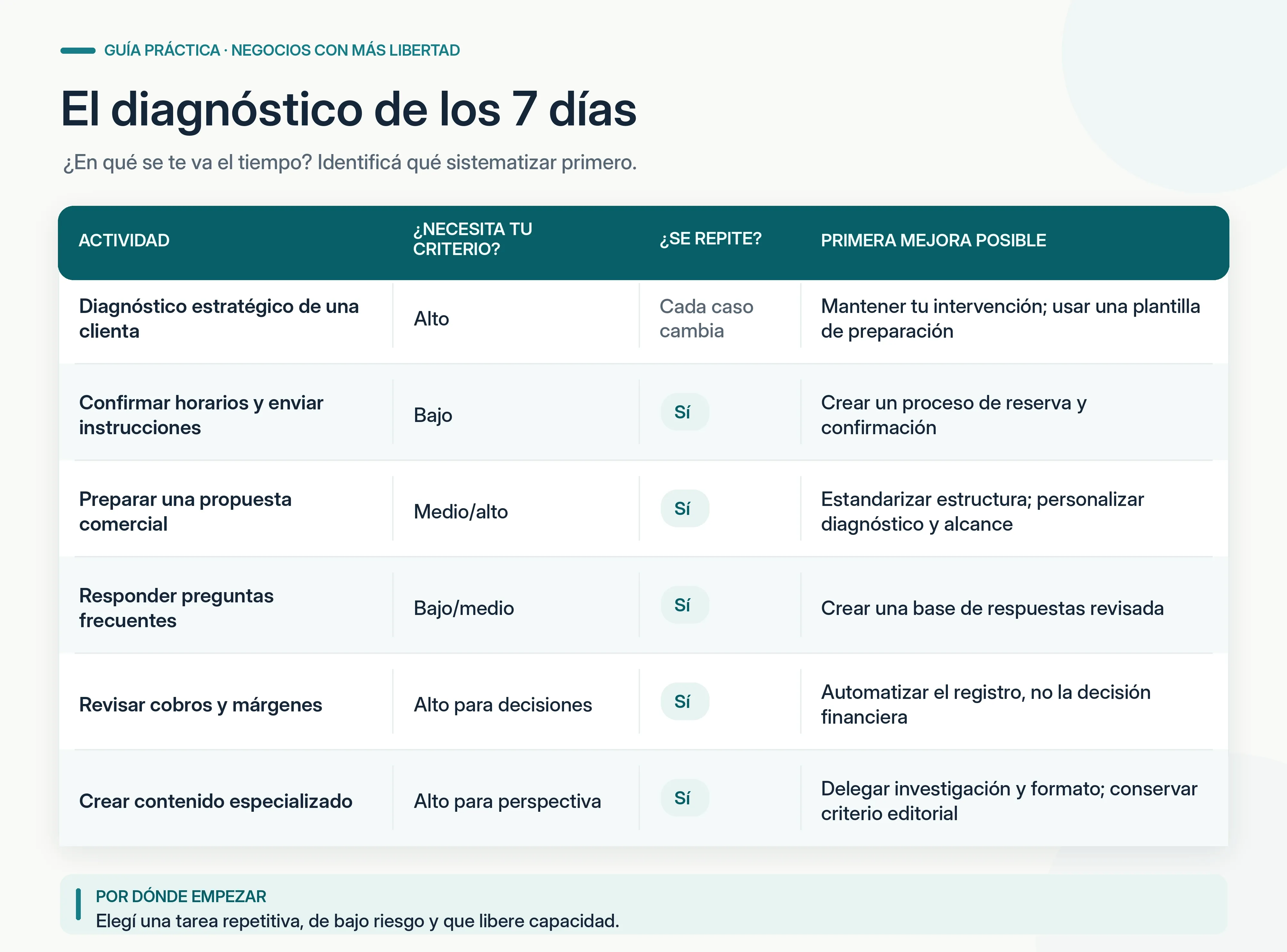
Don't start with the task that annoys you most. Start with a recurring, low-risk task that can free up capacity without compromising the client experience.
A simple metric: hours that depend on you
Add up the weekly hours spent on tasks that cannot continue without your involvement. Separate them from work you personally do because you enjoy it.
Illustrative example: if you work 35 hours and 24 require your direct involvement, estimated operational dependency is 24 ÷ 35 = 69%.
This isn't a universal indicator or a measure of personal worth. Use it as your own baseline for comparison in one or two months. Some tasks should remain personal for quality or confidentiality.
Four levels for building a business with greater freedom
Level 1. Clarity: decide what kind of business you want to sustain
Before taking on more clients, ask yourself:
- How much revenue do I need, and how much remains after costs and taxes?
- How many hours do I want to work, and which hours do I want to reserve for my life?
- Which services do I enjoy delivering personally?
- Which clients and projects are the best fit?
- What growth would I be willing not to pursue to protect my quality of life?
Freedom is a design constraint, not just a future reward.
Example: a professional might choose to spend 20 hours providing specialized services and reject a service line that would require constant availability. That's not a lack of ambition; it's a business model decision.
Level 2. Structure: turn recurring tasks into processes
A process doesn't require a 40-page manual. Start by documenting one task with five elements:
- Trigger: What initiates it?
- Required information: What data is needed?
- Steps: What is the minimum sequence?
- Quality standard: How do you know it was completed well?
- Exceptions: When does a person need to intervene?
For example, "receive an inquiry" might include checking information, classifying the need, responding within defined hours, recording the next step, and escalating sensitive cases.
Documentation makes it possible to delegate, automate, or simply work with less mental load. Even if you work alone, a system keeps you from reinventing every task.
Level 3. Technology: automate predictable work and supervise sensitive tasks
Digitalization can improve small business efficiency, but it also requires adapting processes, skills, and security practices. That's one of the general conclusions of the OECD's 2025 study on SME digitalization.
Reasonable automations to start with:
- Send an acknowledgment after someone completes a form.
- Create a task when an inquiry arrives.
- Send reminders for confirmed meetings.
- Reuse a proposal structure.
- Display the status of opportunities and tasks on a dashboard.
Don't automate without supervision sensitive assessments, hiring decisions, clinical responses, commercial promises, or payments that require validation. AI can help prepare information; it doesn't replace professional responsibility.
The OECD also examines AI adoption among small and medium-sized enterprises and emphasizes that results depend on skills, data, and infrastructure. Buying a tool won't transform a confusing process on its own.
For practical applications, explore our guide to automating your business with AI without technical expertise.
Level 4. Business model: stop selling only your time
Systematizing tasks frees up time; redesigning your offer can change the relationship between income and working hours.
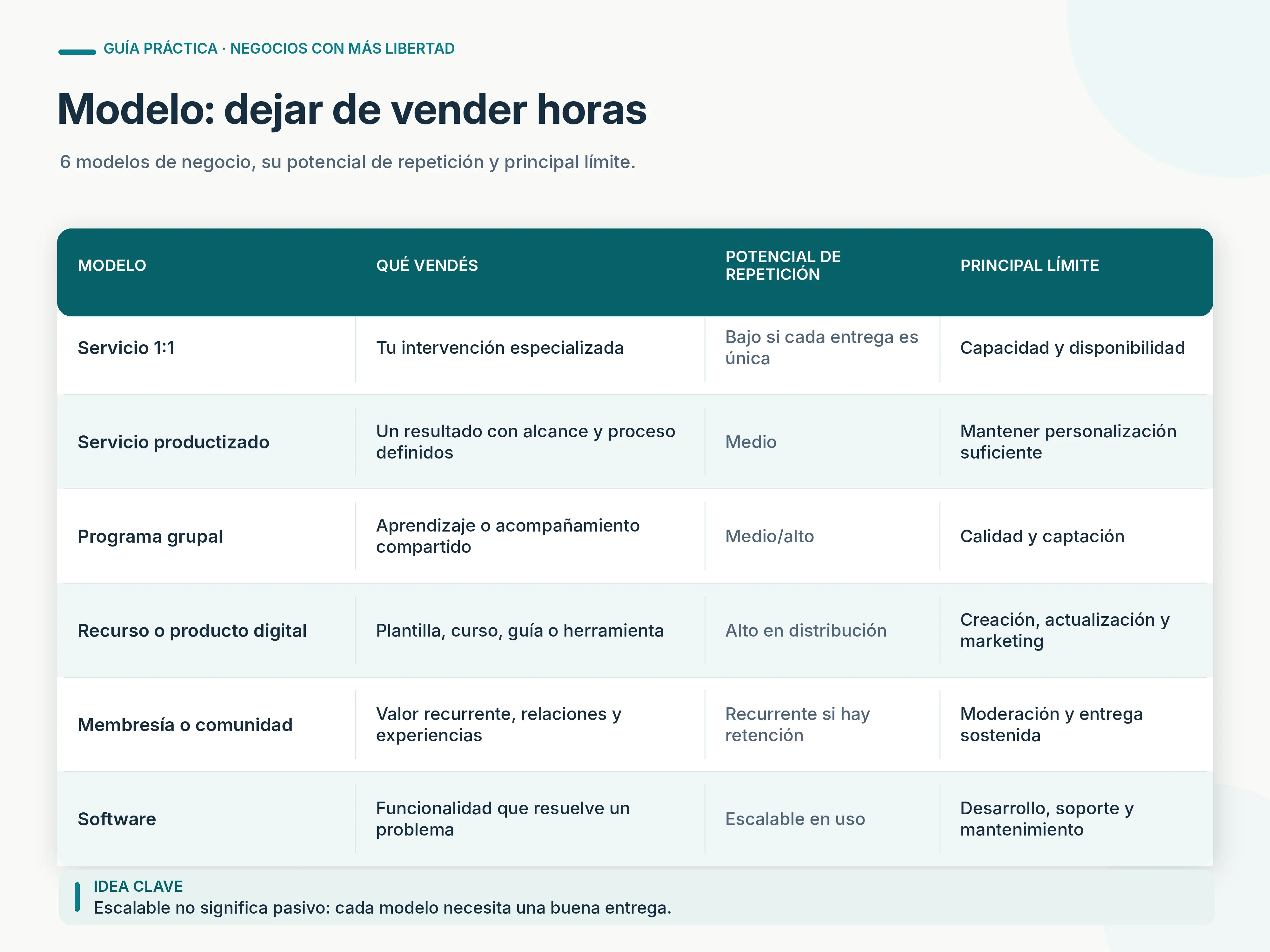
Scalable doesn't mean passive. A course requires support and updates; a membership requires a valuable experience; software requires security and maintenance. A product nobody buys won't create financial freedom.
The strategic question is: What part of my knowledge can I turn into a reusable asset without losing the quality that sets me apart?
The invisible cost of doing everything yourself
Business dependency doesn't occur in a vacuum. Many women combine entrepreneurship with unpaid domestic and caregiving work. The International Labour Organization has documented this burden through research and specific initiatives. A small experiment doesn't represent all women, but it reminds us that available time is not distributed under identical conditions.
That's why recommending "wake up earlier" or "work harder" as a universal solution is rarely useful. Business design should account for energy, responsibilities, health, and personal preferences, not just income.
Nor should we romanticize delegation: hiring without adequate margins, processes, or stable demand can increase financial stress. First establish whether the task is necessary and the improvement makes economic sense.
A four-week plan to reduce founder dependency
Week 1. Measure and choose one bottleneck
For seven days, track recurring tasks and decisions that hold up progress. Choose just one to address. Outcome: a brief diagnosis of what depends on you and why.
Week 2. Document a minimum viable process
Write down the trigger, steps, quality standard, and exceptions. Test it in a real situation. If another person couldn't understand it, simplify it. Outcome: a reusable procedure, not a perfect document.
Week 3. Simplify, automate, or delegate
Ask these questions in order:
- Can we eliminate this step?
- Can we reduce information requirements or approvals?
- Can we safely automate part of it?
- Would it make sense to delegate it to someone qualified?
Outcome: less manual intervention without compromising the experience.
Week 4. Evaluate the actual impact
Review hours freed, errors, response times, satisfaction, and costs. If a system saves two hours but creates four hours of corrections, it isn't working yet. Outcome: decide whether to keep, adjust, or discard the change.
The 48-hour experiment
Imagine disconnecting for two days without abandoning your professional obligations. Which processes should continue working? Which clients need notice? Which decisions can't wait? You don't have to actually take time off to identify weak points.
Write down three answers: what would stop, why, and what the first improvement would be. That list is more useful than buying five new tools.
How can you tell whether your business is growing sustainably?
Don't look at revenue alone. Review these together:
- Margin: what remains after the costs of delivering your service.
- Recurring or predictable revenue: the portion with reasonable continuity, without assuming guarantees.
- Hours of operational dependency: how much work requires your involvement.
- Quality and retention: what's happening to your clients' experience.
- Decision-making capacity: how much time you devote to strategy versus urgent tasks.
- Well-being and available time: whether your business model supports the life you want to build.
A business that generates more revenue while systematically harming your health or eliminating all flexibility may be growing in a direction you didn't choose.
Frequently asked questions
Do I need to hire someone to stop doing everything myself?
Not necessarily. Start by eliminating unnecessary steps, documenting tasks, and automating simple actions. Delegation makes more sense when volume, margins, and clear criteria are in place.
How can I stop selling my time as an independent professional?
Keep your primary service and explore complementary offers: standardized assessments, workshops, group programs, or reusable resources. Test demand before investing too much in product development.
Can a business operate completely without its founder?
Some models significantly reduce daily dependency; others require specialist involvement by choice or regulation. The useful goal isn't to disappear but to consciously decide where your involvement creates the most value.
Build a business that supports your life instead of consuming it
Entrepreneurial freedom isn't measured only by whether you can work from anywhere. It's also measured by whether you can rest, think, learn, and choose without everything stopping.
Start with a concrete question: What decision or task do I repeat every week that could become a system? Choose one, improve it, and measure the change.
If you need to organize your vision before changing your processes, humana created the One-Page Expansive Digital Strategy, an editable template connecting purpose, offer, business model, and next steps. You can also explore how other women entrepreneurs move forward together in our article on masterminds and building businesses through networks.
Join humana for free and design your next stage
Want to build a business that grows without depending on every hour of your time? Join humana for free and access the One-Page Expansive Digital Strategy. Use that map to decide what to sustain, what to simplify, and what to turn into a system.
Further reading: OECD: SME digitalization (2025) · OECD: AI adoption among SMEs (2025) · ILO: Unpaid care work.
Get our best stories
A weekly email with curated editorial content for professional women in tech and business.
Related articles
 Tecnología y Sistemas Digitales
How to Automate Your Business With AI Without Technical Expertise
Your business can keep operating even when you're offline. Discover how AI can handle repetitive work without requiring technical expertise.
 Negocios y Estrategia
Do More With Less: The 80/20 Rule for Better Results Without Working More
Working all day without making progress? Identify the small share of actions that produces most of your results, then prioritize it to increase sales, productivity, and freedom.
 Negocios y Estrategia
The Brand as a System: How Purpose-Driven Design Transforms Industries and Ways of Living
The most influential brands are defined not just by what they sell, but by how they operate. Discover how purpose-driven design transforms industries.