

Working More Is Not Growth: How to Regain Focus Without Burning Out

Florencia Heine
Founder humana Network, Aurora Pilot App & OH Digital Agency
TL;DR
Growth means improving results, margins, and autonomy—not adding hours. Identify value creation, operations, and friction; choose a weekly outcome, protect focus blocks, and simplify one recurring task.
Working More Is Not Growth: How to Regain Focus Without Burning Out
Working longer hours doesn't mean your business is growing. Growth means improving your results and your ability to sustain them without being available all day. To regain focus, distinguish work that creates value, work necessary to operate, and tasks that could be simplified.
Perhaps you know the scene: you finish a day full of messages, meetings, deliverables, and unfinished tasks. You've been busy since morning, but the important proposal still hasn't gone out, you haven't reviewed your numbers, and the idea you wanted to develop has been postponed until "there's time."
The answer isn't another productivity app. It's redesigning what deserves your attention.
Being busy, being productive, and growing are three different things
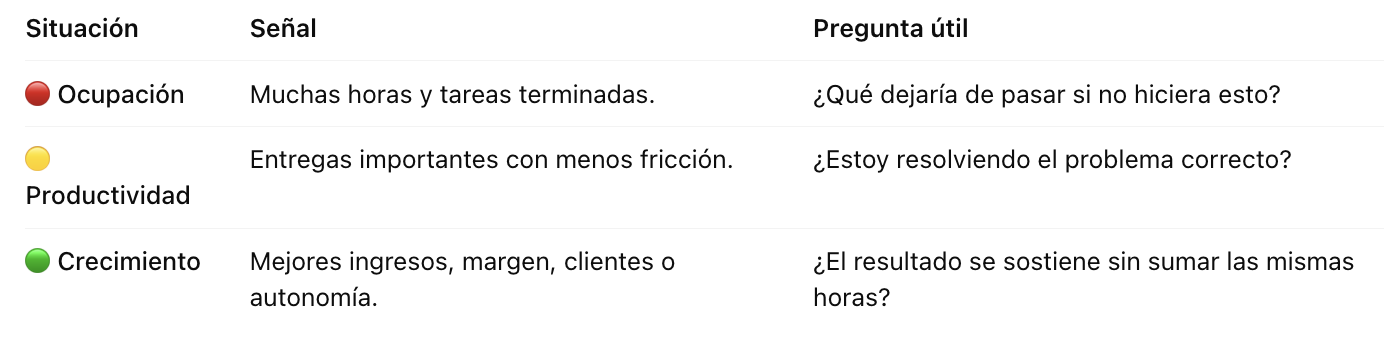
Imagine a consultant who answers 40 messages a day. If she answers 60, she has been busier. If she creates a FAQ page and reduces repetitive inquiries without compromising service, she has improved the system. If she uses the time she frees up to serve clients better and develop a profitable offer, she may be growing.
The right indicator depends on your business model: an independent professional may choose not to scale her client base and still grow in profit margin, quality of life, or impact.
Why working harder can keep you stuck
1. You confuse urgency with value
Notifications seem to demand immediate responses. Strategy, improving an offer, or an important sales conversation can usually wait. That's why they end up losing.
2. Your business runs on memory
If every inquiry, quote, and follow-up depends on you remembering it, your attention becomes infrastructure. A well-organized calendar, CRM, or response template may be more valuable than another hour of effort.
3. You don't measure the cost of switching tasks
Preparing a proposal, answering a message, returning to the proposal, and checking a post may seem like a varied workday. In practice, you interrupt the work that requires judgment. You don't need a perfect morning; you need to protect some uninterrupted blocks.
4. Availability has become part of your offer
When every client expects an immediate response, it's difficult to make time to improve your service. Defining response times and genuine exceptions is also part of designing the customer experience.
A 20-minute focus audit
During a typical workday, record your activities in three groups:
- Value creation: specialized work, offer design, strategic decisions, and relevant sales conversations.
- Business operations: invoicing, coordination, support, follow-up, and administration.
- Avoidable friction: searching for scattered information, repeatedly answering the same questions, recreating documents, or checking tools without a purpose.
Then answer:
- Which activity produced the most important result this week?
- Which task did I repeat at least three times?
- Which decision did I postpone because I didn't have time?
- What does someone else expect from me that a clear rule could resolve?
- What would I stop doing if I only had 25 hours available this week?
Don't use this exercise to judge yourself. Use it to discover how your work is designed.
The three-decision method for regaining focus
Decision 1: Choose an outcome, not an endless to-do list
Instead of "do marketing," define "publish a page that explains my service and lets people request a meeting." Instead of "organize sales," choose "follow up on five open proposals."
An outcome has an observable state: it's done or it isn't.
Decision 2: Protect two deep work blocks
Reserve two 60- to 90-minute blocks each week for tasks that require thinking. Turn off notifications, keep a list to capture interruptions, and communicate when you'll respond. If your work requires continuous availability, start with a shorter block.
Don't fill every gap in your calendar: room for the unexpected is part of the system.
Decision 3: Eliminate, simplify, or delegate one recurring task
Before automating, ask whether the task is still necessary. Automating a pointless process only makes waste happen faster.
For example, if you spend an hour each week copying form data, first review which fields you need; then connect the form to your contact management system; finally, check that no inquiries are lost. If the data is sensitive, evaluate permissions and privacy before integrating tools.
What to measure to know whether the change is working
You don't need a dashboard with twenty metrics. Try these four for a month:
Indicator | How to track it | What it helps you decide |
|---|---|---|
Weekly working hours | Weekly estimate | Whether you're buying growth with more time |
Priority outcomes | 1–3 per week | Whether you're progressing on what matters |
Margin per service | Revenue minus attributable costs | Whether the activity is profitable |
Hours spent on repetitive friction | Approximate log | Which process to improve |
For example, if a professional generates the same revenue in 30 hours that previously required 40, while maintaining service quality, she has gained capacity. But if she reduces hours by leaving clients without answers, she has shifted the cost elsewhere.
Regaining focus doesn't mean ignoring your well-being
The World Health Organization describes burnout as a phenomenon associated with chronic workplace stress that has not been successfully managed. It isn't something that can be diagnosed from a productivity checklist.
The International Labour Organization examines how working hours and their organization affect work-life balance. The solution doesn't always depend on individual discipline: client agreements, caregiving responsibilities, available resources, and how the business is organized matter too.
If exhaustion persists or affects your health, seeking professional support is more important than trying another time management method.
A seven-day plan to move from busyness to direction
Day 1: Record your tasks and choose the most important outcome for the week.
Day 2: Identify three repetitive activities that consume your attention.
Day 3: Define response hours and an exception for genuine emergencies.
Day 4: Protect a strategic work block and complete a concrete deliverable.
Day 5: Document one simple process: trigger, steps, outcome, and exceptions.
Day 6: Review your hours, outcomes, and tasks you could stop doing.
Day 7: Decide what to keep and what to change next week. Don't add ten new habits.
Frequently asked questions
How can I grow if I can't afford to delegate?
Start by eliminating unnecessary tasks, standardizing responses, and organizing information. Delegation can come later; it isn't the first requirement.
What if my work depends on personally serving my clients?
You can preserve the human and specialized aspects of your service. The goal is to reduce friction in scheduling, proposals, payments, and follow-up, not replace your professional judgment.
How do I know if I need a CRM or just a better calendar?
If you manage a few conversations and simple reminders, a calendar may be enough. If you lose context between inquiries, proposals, and follow-ups, a CRM can help you record the next step without relying on memory.
Freedom is something you can design
The question isn't "How do I do everything?" but "What genuinely needs my attention to build the business and life I want?" Growth may mean increasing revenue, achieving a healthier margin, working with better clients, or reclaiming time.
If your business only moves forward when you personally push every piece, read our guide to building a business that depends less on you.
Join humana for free and build with more clarity
At humana Network, we connect women who want to build businesses with direction, resources, and a community so they don't have to do everything alone. Create your free humana account to explore the resource library and opportunities to connect with other women entrepreneurs.
Sources: WHO: Burnout as an occupational phenomenon · ILO: Working time and work-life balance · ILO: Business and working time.
Get our best stories
A weekly email with curated editorial content for professional women in tech and business.
Related articles
 Marketing y Ventas
Does Your Personal Brand Attract Clients and Business Opportunities?
Your personal brand should do more than attract followers. Audit your LinkedIn profile, connect content to your offer, and measure real business opportunities.
 Negocios y Estrategia
Does Your Business Depend Too Much on You? How to Start Building Freedom
Does your business stop when you disconnect? Learn how to measure founder dependency, create processes, and gain freedom with a four-week plan.

 Negocios y Estrategia
Mastermind for Women Entrepreneurs: Build Your Business Together, Not Alone
Join a mastermind for women entrepreneurs: monthly online circles of five to seven women to make better decisions, connect, and test business ideas.