
The Ultimate Guide to Product-Market Fit: Align Your Passion With What Customers Want to Buy

Humana Network
Editorial
TL;DR
Use the Value Proposition Canvas to map customer jobs, pains, and gains against your products, pain relievers, and gain creators. Interview real customers, refine your offer, and test it over 30 days.
The moment it clicks: why effort alone isn't enough
You've probably heard that entrepreneurship is about working hard. Yet many women work tirelessly on projects that sadly have little demand. It feels like trying to fit a square puzzle piece into a round space.
Product-market fit is that moment when the piece fits. You stop chasing customers and start attracting them because your product feels like a natural answer to their problems.
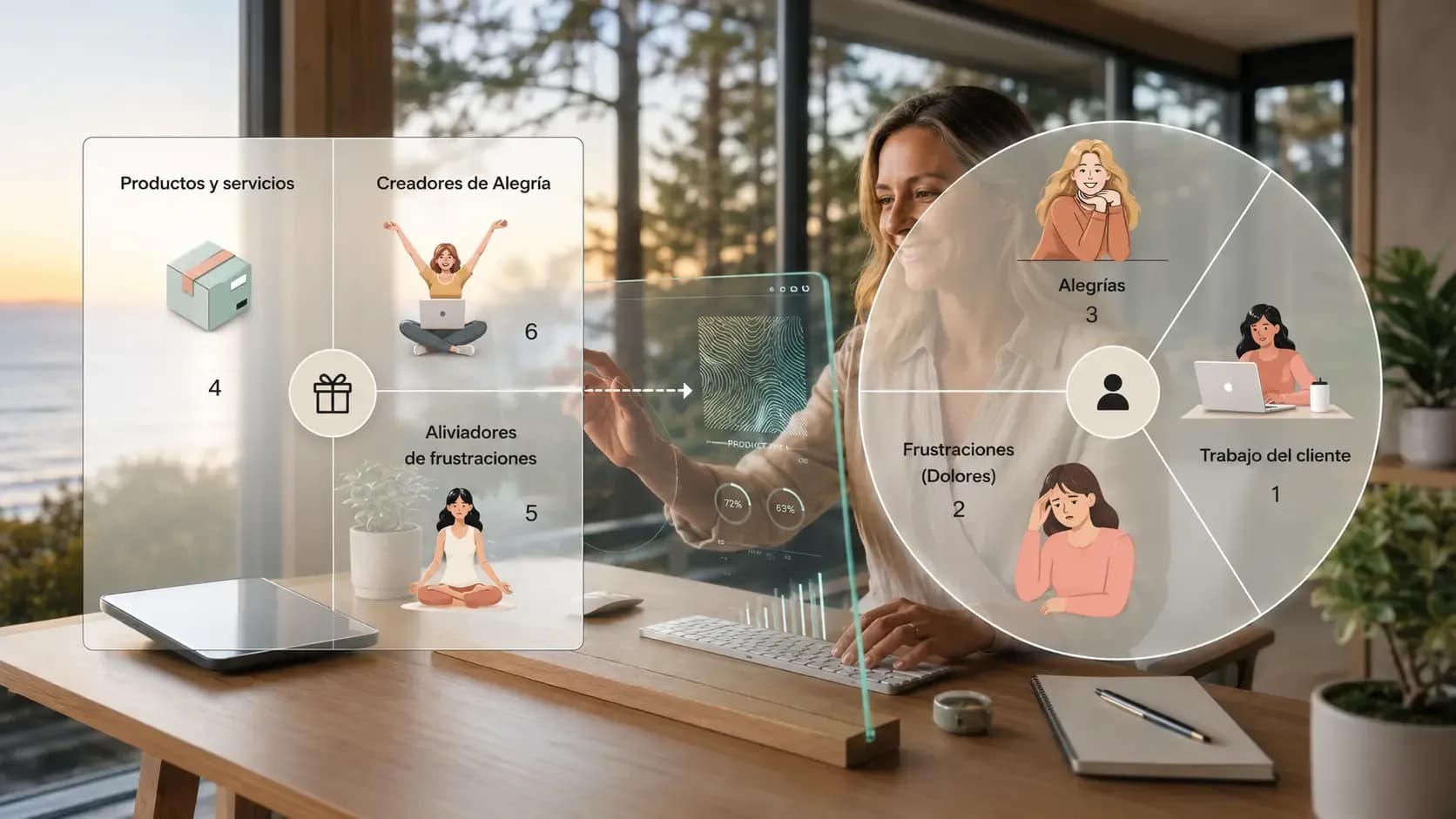
To work toward it, we'll use the Value Proposition Canvas, which divides your strategy into two worlds that need to meet: your customer (the circle) and your offer (the square).
Part 1: The customer profile (understand before you sell)
Before examining your product, look at the woman you serve. The circle represents her reality, fears, and desires.
1. Customer jobs
It's not just what she does, but what she's trying to achieve in her personal or professional life.
What it means: tasks your customer is trying to accomplish. They can be functional (finish a report), social (gain status among friends), or emotional (feel confident).
How to apply it: list the three main tasks your customer tries to complete when seeking a solution like yours.
Example: "Organize my schedule so I can spend more time with my children."
2. Pains
This is where empathy comes in. Identify what bothers your customer before, during, and after attempting her job.
What it means: risks, obstacles, and unwanted outcomes. What keeps her up at night? What is she afraid of? What costs her time or money?
How to apply it: identify the most acute pain. Don't try to solve 20 problems; choose the one that hurts most and focus on it.
3. Gains
Beyond solving a problem, what would make her smile?
What it means: benefits the customer expects or desires. It's not just about something working, but being easy to use, aesthetically pleasing, or creating a sense of belonging.
How to apply it: ask yourself, "What would pleasantly surprise my customer most?"
Part 2: The value map (your strategic solution)
Once you understand the circle, the square is your response. This is where you design your value proposition to make it compelling.
4. Products and services
This is the inventory of what you offer.
What it means: a tangible list of products or services that help the customer accomplish her jobs.
How to apply it: ensure every product on the list directly connects with one of the jobs you defined in step 1.
5. Pain relievers
This is where conversion starts to happen.
What it means: describe exactly how your products eliminate or reduce your customer's frustrations. Do you save time? Reduce stress? Make something difficult simple?
How to apply it: write a clear sentence: "My product eliminates [Pain X] through [Feature Y]."
6. Gain creators
This is what differentiates you from the competition.
What it means: explain how your offer produces the benefits customers expect or desire. It's the added value that makes them choose you over someone else.
How to apply it: focus on the user experience. How do you help her feel empowered or happy when using your service?
How do you know whether you have a fit?
Alignment between your pain relievers and gain creators (your offer) and your customer's pains and gains (her reality) is central to working toward product-market fit. If your pain relievers aren't aligned with real customer pain, the market may ignore you.
The 30-day process:
Days 1–10: Interview five real customers. Don't sell to them; listen. Fill the circle (1, 2, 3) using their words, not yours.
Days 11–20: Adjust your square (4, 5, 6). Change your website messaging and redefine your service packages.
Days 21–30: Launch a small test. Measure whether resistance to buying has decreased.
Ready to stop guessing and start growing?
Understanding the theory is the first step, but putting it on paper is what transforms businesses. At humana Network, we want you to have access to powerful business tools in a simple format.
Download our editable Canva Product-Market Fit Template.
With this visual template, you can map the six points we've reviewed, identify gaps in your strategy, and redesign an offer that customers are eager to buy.
Get our best stories
A weekly email with curated editorial content for professional women in tech and business.
Related articles
 Marketing y Ventas
Does Your Personal Brand Attract Clients and Business Opportunities?
Your personal brand should do more than attract followers. Audit your LinkedIn profile, connect content to your offer, and measure real business opportunities.
 Bienestar y Vida Emprendedora
Working More Is Not Growth: How to Regain Focus Without Burning Out
Being busy isn't the same as growing. Learn how to regain focus, reduce repetitive tasks, and build a business without working longer hours.

 Negocios y Estrategia
Does Your Business Depend Too Much on You? How to Start Building Freedom
Does your business stop when you disconnect? Learn how to measure founder dependency, create processes, and gain freedom with a four-week plan.